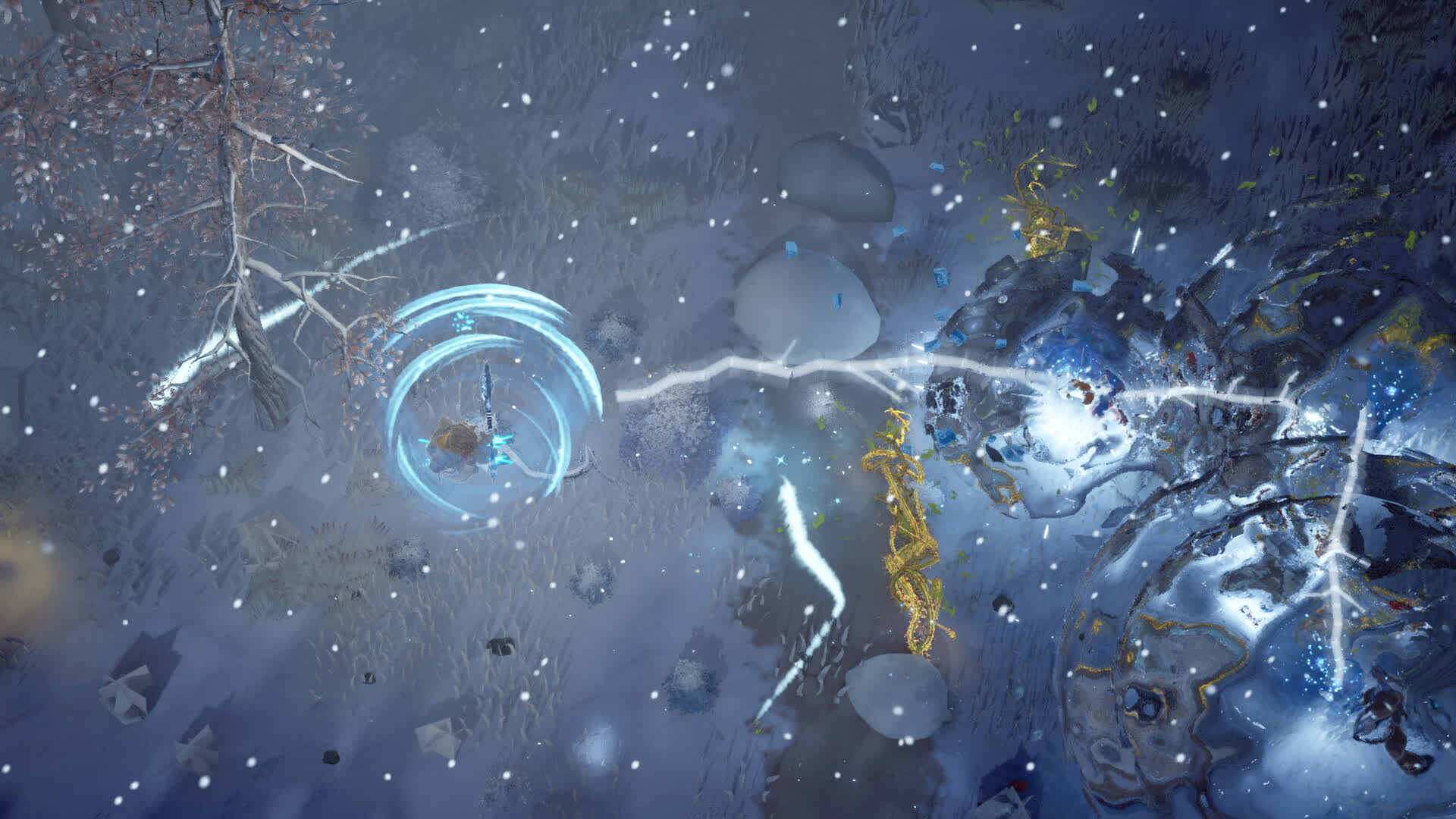
Skill gems and supports: the engine room
The store’s clearest design promise is that supports change how a skill works, not just how big its number is. A Cyclone can fire Ember Bolts while you channel. Arrows can rain in a chosen element. This page turns those examples into a way to read the system before launch.
What is actually confirmed
| Element | Confirmed | Still unknown |
|---|---|---|
| Skill gems | Exist; each class has its own skills | Full list, tags, level curve, drop sources |
| Support gems | Link to skills and change behaviour | Number of links, socket colours, mana cost, availability |
| Examples | Cyclone + Ember Bolts; burning legion; elemental arrows | Which class gets which, and whether the examples are endgame-viable |
| Skill bar | At least eight slots; Q W E R T plus extras | Whether all slots are active skills or some are auras |
| Gem level | Lv 20 visible in official screenshots | Max level, corruption, quality, awakening |
| Respec | Passive tree refunds cost 2 gold a node in the shown build | Whether gems can be refunded or swapped freely |
How to read a support gem
Every support in this genre does at least one of four things. The store’s examples map onto the same four categories, which is why they are useful even without a gem list.
It adds a delivery
A projectile, a chain, an area explosion or a trigger. Cyclone firing Ember Bolts is the flagship example: the support changes the shape of the skill, not just its damage.
It converts a type
Physical to fire, fire to chaos, arrows into a chosen element. Conversion supports are usually the difference between a novelty and a build.
It changes cadence
Faster casts, repeats, channels, totems or traps. These supports decide whether you stand still or keep moving.
It adds a cost
More mana, less life, a cooldown, a delayed payload. The best supports in ARPGs are the ones whose cost you can actually solve.
What the playtest is showing
The store gives three examples. The playtest gives more, though none of it is documented. These are the interactions creators are reporting; we have not verified them.
| Reported link | What it implies | Confidence |
|---|---|---|
| Storm Whirl → Storm Sparks → Zap (cast-on-crit) | Triggers can chain multiple effects from one cast; crit may be a trigger enabler, not just damage | Creator-reported |
| Winter Orb → the same spark chain | A persistent skill can be the engine for a trigger setup | Creator-reported |
| Cyclone + Ember Bolts | A channelled melee skill can add a projectile while channelling | Official store example |
| Leap Slam + crit | Slam skills can scale with crit and supports | Creator-reported |
| Build codes beginning BO1. | Builds can be exported/imported as strings | Two creators |
Your first three links
Do not try to build a six-link engine in the first hour. The launch-morning order that survives patches is:
-
Make the skill usable
If the base skill is slow or small, take the support that fixes the feel — area, projectiles, cast speed — before the damage support.
-
Add one behaviour change
The store’s design language rewards a support that makes the skill do something new. Pick one and learn its cost.
-
Solve the resource
Mana, life or cooldown. A support that doubles your damage but empties your globe is a downgrade in a long Rupture.
-
Add damage last
Once the engine runs, raw damage supports scale it. Before that, they only make a clunky skill hit slightly harder.
The three official examples, unpacked
Cyclone + Ember Bolts
This is the most important sentence on the store page. A channelled melee skill can be made to fire a projectile while you channel. It implies supports can add a trigger and a second skill to a primary skill. If the cost is manageable, it is the kind of interaction that defines a league starter.
The burning legion
Minions plus fire. The phrase suggests either a fire-conversion support for minions or a minion skill that inherently burns. It is the clearest hint that the Necromancer’s army is intended to scale with elemental supports, not just physical damage.
Arrows in your chosen element
A projectile skill whose damage type is selectable. The interesting part is not the element; it is the word chosen. If the choice is made in the gem or the tree, it changes how a Ranger plans around enemy resistances.
Launch checklist
- Find the gem vendor or drop source before you plan a six-link.
- Check whether supports have stat requirements (Str/Dex/Int) — the passive tree shows all three attributes.
- Test whether a support can be removed without destroying the gem.
- Note the mana multiplier of every support you link.
- Write down the exact names. The wiki will need them for the first real build pages.